

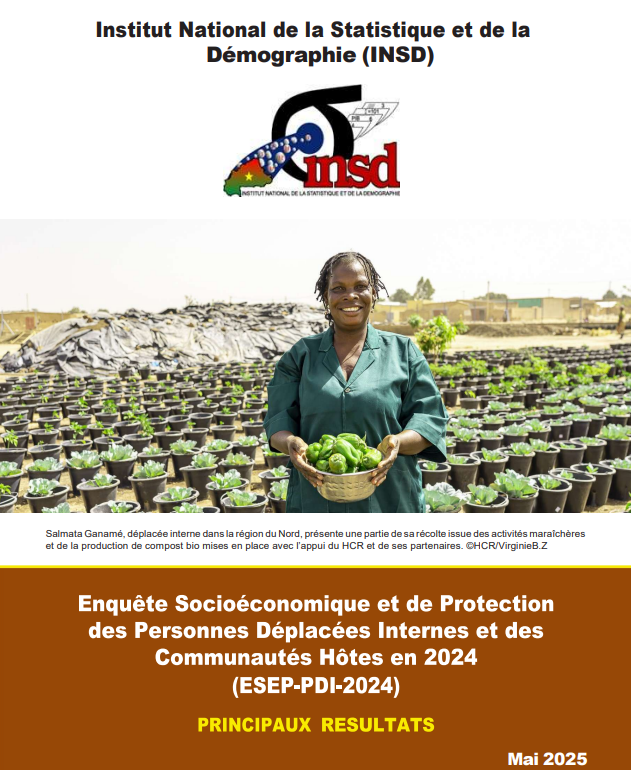
The Enquête Socioéconomique et de Protection des Populations Déplacées Internes et des Communautés Hôtes (ESEP‑PDI) provides findings from one of the first integrated socioeconomic conditions, protection risks, and solutions survey of internally displaced persons (IDPs) and host communities in Burkina Faso. The survey was implemented by the Institut National de la Statistique et de la Démographie (INSD) in partnership with UNHCR, with technical and financial support from the World Bank–UNHCR Joint Data Center on Forced Displacement. Conducted across six regions, the study captures a range of displacement contexts affecting IDPs and host communities.
The study sheds light on living conditions in the context of prolonged insecurity and widespread humanitarian needs. The findings reveal that internally displaced households experience high levels of multidimensional poverty and food insecurity, reflecting overlapping challenges related to education, health, livelihoods, and housing conditions. At the same time, many displaced households report feeling safe in their current locations and describe positive relations with host communities, highlighting the importance of local integration pathways. While prospects for return to areas of origin remain uncertain for most displaced people, many still view it as an option, largely dependent on improvements in security conditions.
The ESEP-PDI provides an important evidence base for designing responses that address the immediate needs of displaced households while supporting pathways to durable solutions. It also represents a significant step in strengthening Burkina Faso’s national statistical system to produce sustained, policy-relevant evidence on forced displacement.