

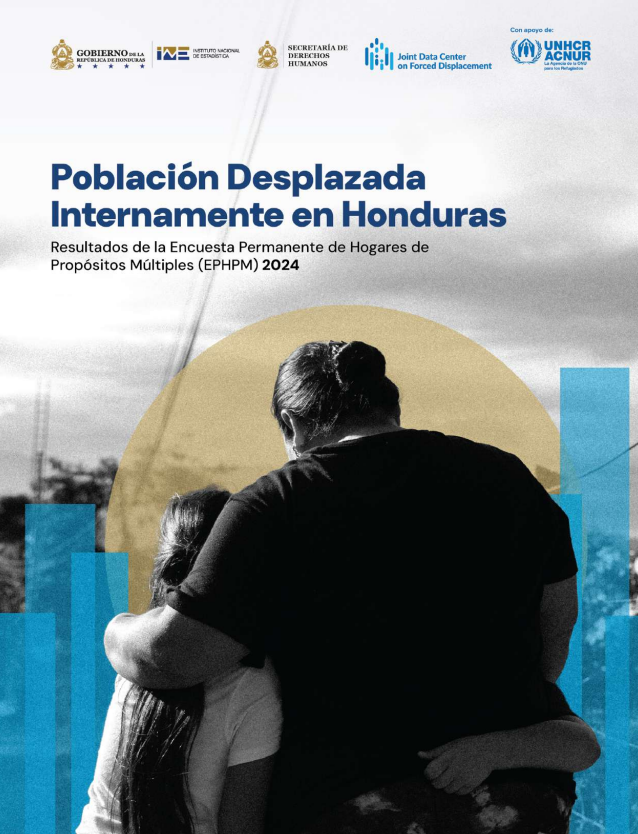
The publication Resultados de la Encuesta Permanente de Hogares de Propósitos Múltiples (EPHPM) 2024 presents nationally representative evidence on people internally displaced by violence in Honduras. The report draws on data from the June 2024 round of the Permanent Multipurpose Household Survey (EPHPM by its Spanish acronym), conducted by the Instituto Nacional de Estadística (INE), to compare the demographic and socioeconomic characteristics, living conditions, and health status of internally displaced people with those of the non-displaced population.
People displaced by violence are defined as those who, at any point in their lives, changed residence because they did not feel safe in their neighborhood or were forced to move. As of June 2024, 4.5 percent of the Honduran population reported having experienced internal displacement under this definition.
The findings show that while overall socioeconomic differences between displaced and non-displaced populations are relatively limited, more significant gaps exist in access to health care, food security, perceptions of safety, and exposure to climate-related vulnerability.
Drawing on national household survey data collection, the analysis helps generate evidence on internally displaced populations to inform policy, planning, and service provision.
The report was produced by INE with technical and financial support from UNHCR and the World Bank—UNHCR Joint Data Center on Forced Displacement.