

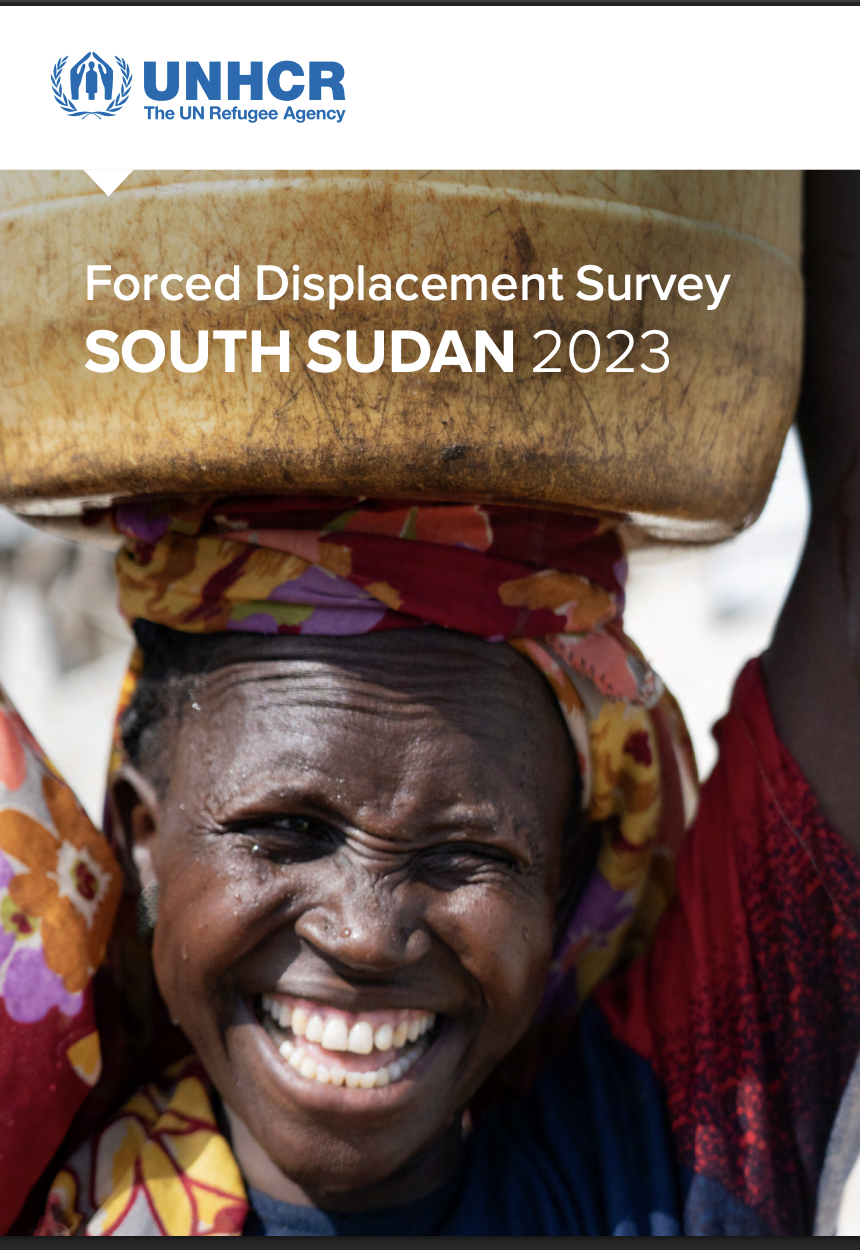
The Forced Displacement Survey (FDS)—South Sudan 2023 is the first nationally representative survey of refugees and host communities in the country. It assesses legal status, living conditions, access to services, livelihoods, and household resilience, generating evidence to inform policy and operational responses.
As of March 2023, South Sudan hosted approximately 298,000 refugees, the vast majority from Sudan, many in protracted displacement for more than a decade. The findings show a predominantly young population, with close to 60 percent under age 18, alongside gaps in access to basic services, high exposure to shocks—including flooding and rising prices—and limited participation in formal labor markets. At the same time, high levels of registration and documentation reflect South Sudan’s established refugee framework.
The survey was implemented by UNHCR in partnership with the Government of the Republic of South Sudan and the National Bureau of Statistics, with financial and technical support from the World Bank–UNHCR Joint Data Center on Forced Displacement and the Government of Denmark. It strengthens national statistical systems and supports coordinated humanitarian and development planning.
Thematic briefs
Navigating the Complexity of Return: Findings from the Forced Displacement Survey
Examines refugees’ return intentions and the conditions shaping sustainable return and reintegration.
Education outcomes of refugees and hosts: Comparative analysis in South Sudan
Uses the Forced Displacement Survey 2023 to examine barriers to school enrolment, attendance and completion among refugees and nearby host communities.
Access to Land, Agriculture and Food Security in South Sudan
Draws on the Forced Displacement Survey 2023 to examine the links between land access, agriculture, livestock, and food security among refugees and nearby host communities.
Multidimensional poverty of refugees and host communities in South Sudan
This brief examines multidimensional poverty among refugees and host communities in South Sudan. It finds that nearly the entire population, refugees and hosts alike, is poor or vulnerable to poverty, driven equally by deprivations in education, health, and living conditions. It also identifies a strong link between poverty and mental health, pointing to a possible psychological poverty trap that can undermine self-reliance. Produced by UNHCR with support from the World Bank–UNHCR Joint Data Center and South Sudan’s National Bureau of Statistics, the findings call for sustained, development-oriented responses led by government.