
These two policy briefs draw on the 2024 Socio-Economic Assessment of Refugees and Host Communities in Moldova, a nationwide survey of refugee and host community households conducted by UNHCR with technical and financial support from the World Bank–UNHCR Joint Data Center on Forced Displacement (JDC). Together, they examine how refugees from Ukraine can be more included in Moldova’s labor market and public services.
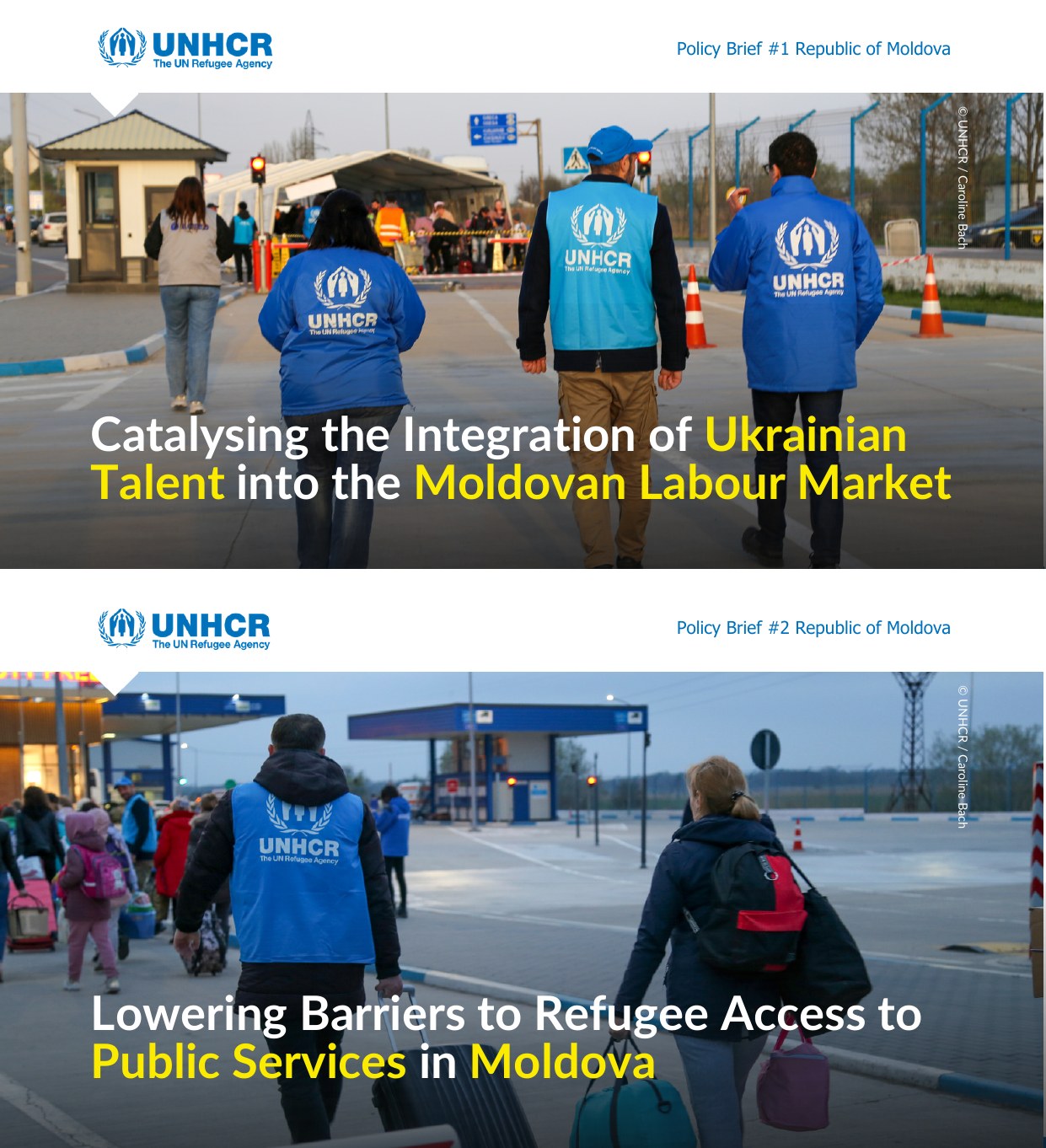
Catalyzing the Integration of Ukrainian Talent into the Moldovan Labor Market shows that refugees bring strong human capital—77% hold vocational or higher qualifications—yet only 29% have found paid work. Language, unrecognized qualifications, limited childcare, and low wages are key barriers. The brief recommends employment-focused Romanian language courses, fast-track diploma recognition, expanded childcare, and self-reliance procedures.
Lowering Barriers to Refugee Access to Public Services in Moldova finds that, despite broad rights under Temporary Protection, refugees face practical obstacles: complex procedures and information gaps, financial barriers, language, and limited service capacity. It calls for multilingual public service portals, voluntary enrollment of Temporary Protection holders in national health insurance, standardized school registration, and pathways into national social assistance schemes.
The survey data underpin the Analysis of Refugee Economic Inclusion by the Moldova Inclusion and Solutions Working Group.